Next Reign: Kingdom Production Planner
A red-arrow checklist: wheat, wood, bars, tools, and an idle army, in the order the chain actually runs.
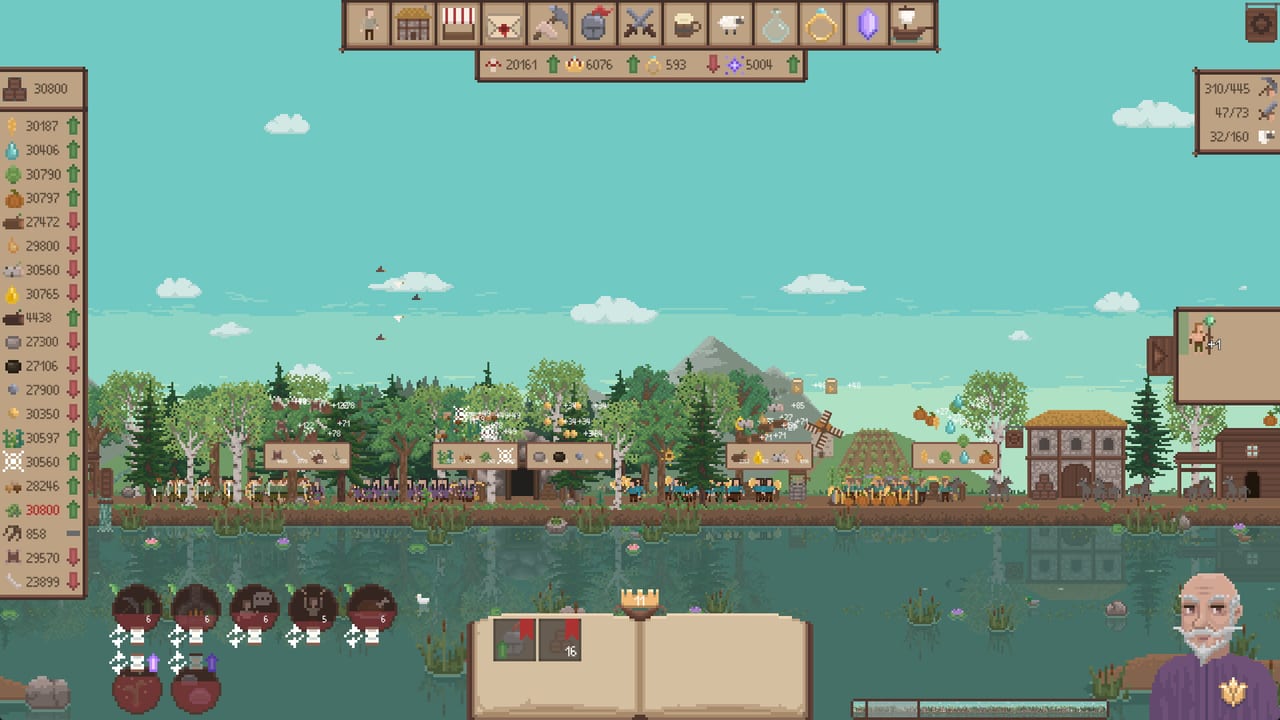
Look at the left side of the HUD before you look at the skyline. Next Reign: Kingdom’s v0.3 interface puts resources in an open book with green and red arrows. Green means the stock is rising. Red means you are spending faster than you print, or you printed into a full warehouse, or the job that makes the thing does not exist. This planner is the order of operations for those arrows. It matches the building priority list and the long-form production chains page. It does not replace the prestige planner; it tells you whether the current reign can still move.
Chain order (always this, not the order buttons unlock)
| Step | Output | Who / what prints it | Usually blocked by |
|---|---|---|---|
| 1 | Wheat | Farmers (houses first) | No beds, no farmers, all wheat sold at the market |
| 2 | Wood | Lumberjacks | No lumberjacks, all wood sunk into a market or extra warehouse |
| 3 | Stone | Miners | No miners, no houses left for them |
| 4 | Coal | Miners after the coal shaft | Shaft not built, miners still on stone only |
| 5 | Iron ore | Miners on the ore job | Same as coal: wrong mine, no warehouse room |
| 6 | Iron bars | Iron smelter (ore + coal) | Smelter missing, coal missing, cap full |
| 7 | Tools | Tool smithy (bars) | No bars, smithy missing, tools not assigned to worker tiers |
| 8 | Hops and later goods | Experienced / tiered farmers and later buildings | Tools never spent on the worker upgrade |
| Side | Favor | Market trades | Wheat or wood still red, market not built |
| Side | Glory / remains | Combat quests | No line of defense, no peasants, wipe not rebuilt |
If you skip a row because a later building looked exciting, the arrow on an earlier row will go red and stay red. Castle, docks, ships, and the windmill sit after this table on purpose.
If wheat is red
Wheat is food, hiring fuel, and the first trade card. Red wheat is almost never “need a warehouse.” It is almost always “need farmers,” which is almost always “need houses,” which is often “need wood.” Do this in order:
- Count empty beds. If there are empty beds, hire farmers before you hire anyone else.
- If there are no beds, place houses. If you cannot afford houses, you do not have a wheat problem, you have a wood problem — jump to that section.
- Stop selling wheat on hungry-peasant trades until the arrow is green again. Favor is not worth a dead population.
- If farmers exist and wheat is still red, you are spending it on hiring faster than they print. Pause hiring for a minute. Let the stock climb.
- After tools exist, upgrade farmers toward the experienced tier that also pulls hops. That is a yield fix, not a house fix.
Prestige farmer yield (the ~200% after-multipliers node) is the permanent version of this section. Take it on the first crown. Do not take starting stock and hope the red goes away.
If wood is red
Wood is houses, warehouses, the market bill, the smelter bill, and the smithy bill. It is the tax on every good decision. Red wood means you built something handsome with the last logs.
- Hire lumberjacks into any spare beds. If there are no spare beds, the next house is the wood fix and the wheat fix. That tension is the game.
- Stop placing warehouses, walls, or a market while the arrow is red. Those buildings are wood sinks. They wait.
- If the market is already up and a trade wants wood, skip that card. Wheat-for-wood is the card you want, not wood-for-favor, until lumberjacks catch up.
- Mouse-gather on the trees if you are still in the opening and the job count is tiny. That is legal. It is also a sign you need more lumberjacks, not a lifestyle.
- Cheaper buildings on the prestige tree is the structural fix. A 25% discount is several extra houses over a reign.
A special case: wood is red because you just hired a wave of workers. Hiring costs wheat and wood as the count climbs. That is not a production bug. Pause the hire button, let lumberjacks work, then hire again.
If bars stall
Bars are the first crafted resource that feels like a factory. They stall for three boring reasons and one sneaky one.
| Symptom | Fix |
|---|---|
| No smelter | Build it when coal and ore exist. Wood + iron on the bill — see the wood section if that is the block. |
| Smelter exists, coal is flat | Build the coal shaft. Point miners at coal. A second smelter will not print coal. |
| Ore is flat | Same miners, different job. Do not steal every miner off stone if stone is also the next building tax. |
| Stocks are full | Warehouse. This is the one moment a warehouse is the correct click. |
| Auto craft is off and you forgot to queue | Queue bars. After the prestige auto-craft node, treat a stall as fuel, not clicking. |
Do not spend the last bars on extra peasants while the smithy is hungry. Peasants are a C-tier army. Tools promote the workers who print the next bars.
If tools stall
Tools eat bars. If tools stall, bars stalled first unless the smithy is missing.
- Confirm the tool smithy is placed. It wants wood and iron on the construct bill, then bars to run.
- Confirm bars are actually moving. If they are not, this is a bars stall wearing a tools hat.
- Do not hoard tools for a rainy day. Spend them on worker tiers. Experienced farmers and the later collection bonuses (25 and 50 workers of one type on the prestige tree) want a real job count, not a museum of unused tools.
- If combat is begging for iron bars at the same time, peasants lose. One free peasant is enough to open Humble Beginnings. Extra peasant purchases are how smithies starve.
If combat is idle
An idle quest log is a production issue until it is not.
- Is the line of defense built? If not, you do not have combat yet. That is a building priority, not a unit problem.
- Do you have the free peasant? Train it. Open formations. Beat the water slime. Glory and remains start here.
- Are you wiped and staring at an empty field? Rebuild the front — spearmen, then a shield tank — before you open the Blade Queen again. Blobbing peasants is not a rebuild.
- Are bars and tools red while you try to mass an army? The army is stealing the factory. Pause combat purchases until the smithy is green.
- If you already own auto combat prestige and quests still sit idle, the auto node cannot start a quest you have not unlocked or cannot staff. Check the formation preset so a mage is not the only body on a contact tile.
Combat currencies (glory, remains) are extra prestige types. They are worth turning the log back on once the line exists. They are not worth turning the village red.
A one-screen rebuild after a crown
Houses, farmers, lumberjacks, miners, warehouse when a cap bites, market when wheat can survive a trade, walls when the peasant is affordable, smelter, smithy. That is the whole planner in one breath. If a prestige node dropped extra houses or a smelter into the new reign, start at the first red arrow you actually see, not at wheat out of habit. Then, when the field cannot print the next point, stop diagnosing and open the prestige planner. A perfect chain that is out of milestones is a crown, not a third warehouse.
Frequently Asked Questions
Quick answers for new rulers and returning prestige runners.
Wheat is red. Do I prestige?
Not on a first reign. Hire farmers or place houses. Only open the prestige planner if you already have six points and the chain is actually dead.
Wood is red after I built the market. Now what?
Stop trading wood away and hire lumberjacks. A crown will not refund those logs; save prestige planner for when six points are sitting unused.
Bars stalled but I have a smelter. What did I miss?
Coal, ore, or warehouse cap. If those are fine and you still want a reset, check the prestige planner auto-craft row before you throw the reign.
Tools are not moving. Should I buy more peasants?
No. Peasants eat the bars the smithy wants. Fix the bar chain, then spend tools on worker tiers. Prestige timing is still the prestige planner.
Combat quests are sitting idle. Is that a production stall?
Until walls and a peasant exist, yes. After that it is army composition. If the whole reign is frozen at six points, then it becomes a prestige planner question.